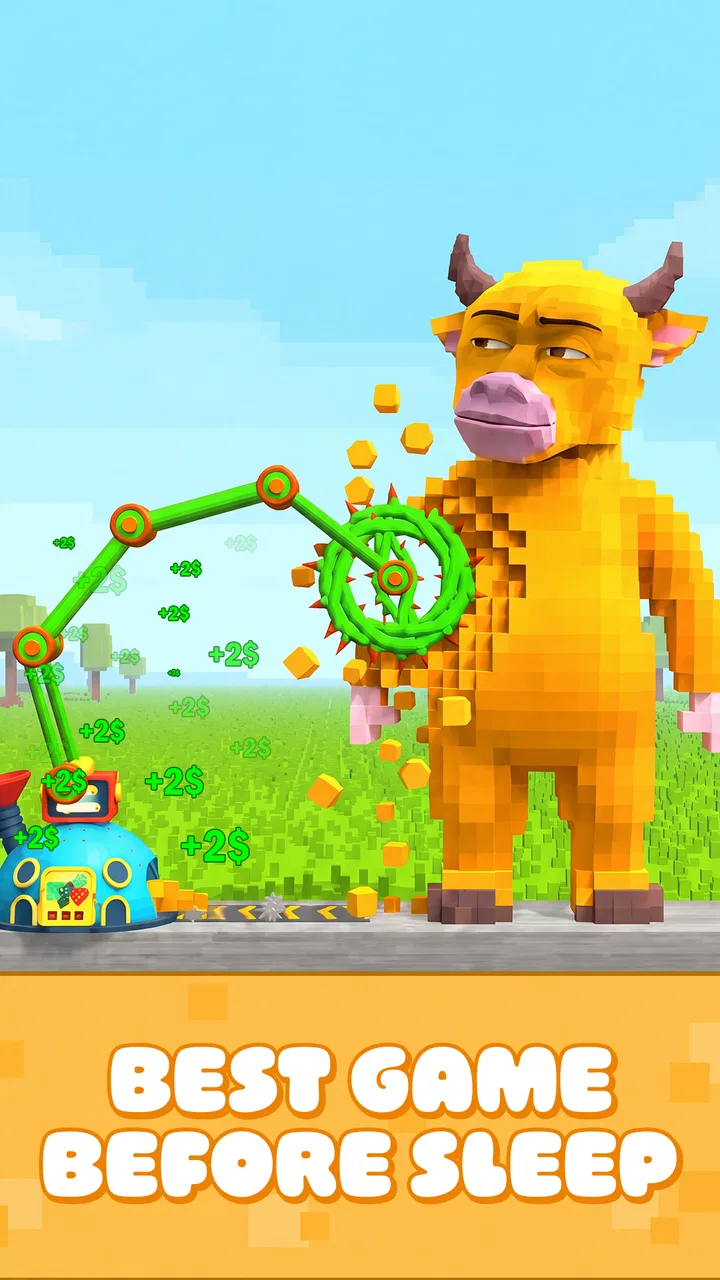
Block Crusher: Bucket Teardown
- 4.5
- Rating
- 10.00M
- Installs
- Free
- Price

 Analysis by App-foxy
I went into Block Crusher: Bucket Teardown expecting a simple time-filler, and that is exactly where this casual game makes the most sense. It is not trying to replace a deep puzzle game or a long-form action title. Its appeal is the quick satisfaction of breaking blocks, clearing space, and watching a small task become visually tidy. After spending time with it, my main conclusion is straightforward: this is a pleasant pick-up-and-play game for short breaks, especially if you enjoy uncomplicated destruction and do not need a lot of strategic depth.
The game comes from Monster Game Studio - OneSoft and is free to install. Its Everyone age rating makes it an easy recommendation for families looking for something accessible, while the large player base—more than ten million installs and an average rating of 4.5 from roughly forty-four thousand ratings—suggests that its simple idea has found a broad audience. Those figures do not make it automatically perfect, but they do fit my experience: the basic appeal is immediate, and you do not need a tutorial-heavy introduction to understand what you are meant to do.
Why the block-breaking loop works so well
The strongest part of the game is its clarity. The store short description calls it “Block Crusher,” and that is a fair summary of the central experience without pretending it is more complicated than it is. I can open it when I have only a few minutes, begin interacting with the level almost immediately, and get a visible sense of progress from each successful action. That direct feedback is the reason it works better as a casual distraction than as a game demanding long, uninterrupted sessions.
You May Also Like

 Blood Strike: 2.5 Anniversary
Blood Strike’s Loadouts Turn Every Drop Into a Tactical Gamble
A close look at Blood Strike’s custom loadouts: how fast access to signature weapons reshapes its battle royale rhythm, rewards preparation, and narrows the gap between fights.

 Pandora - Music & Podcasts
Pandora’s Music Is Easy to Start, but Harder to Recover
Pandora’s strength is its low-effort path from a seed to a station. Its weak spot is how much confidence it asks you to place in connection, setup, and quiet recovery.

 8 Ball Pool
 Is Built on Rivalries, Rematches, and Routine
A close look at the rivalries, rematches, shared routines, and unanswered safety questions that turn a quick pool match into a persistent mobile community.

 Samsung Music
’s Quiet Strength Is Playing What You Already Own
Its reach comes less from spectacle than from dependable access to a personal library. That simplicity is both the app’s strongest retention engine and its ceiling.

 AccuWeather: Weather Radar
AccuWeather Review: A Quick, Clear Forecast for Everyday Decisions
For everyday plans, the best forecast is the one you can understand quickly. AccuWeather makes rain timing, radar, and local conditions easy to act on, with a few trade-offs.

 Hill Climb Racing
Why Hill Climb Racing Still Turns Crashes Into One More Run
A tiny car, a bumpy hill and one more upgrade: Hill Climb Racing keeps resurfacing because its simple chaos makes every near-miss feel personal.
More From Our News Desk



There is a particular satisfaction in games built around removing clutter. Each broken section makes the play area feel more manageable, and that gives even small actions a useful rhythm. I found myself naturally settling into a repeatable pattern: look at the available blocks, decide which part seems most useful to clear first, then continue until the scene feels more open. It is not the kind of decision-making that requires a notebook, but it is enough to keep the activity from becoming completely passive.
The summer-themed presentation also gives the experience a lighter mood. The store summary describes it as summer block-crushing fun, and that tone matters because the game is best approached casually. I would not choose it when I want a tense challenge or a story with emotional weight. I would choose it while waiting for an appointment, taking a short break from work, or relaxing at the end of the day when I want something more interactive than scrolling but less demanding than a competitive game.
One useful habit is to avoid treating every move as equally valuable. When the play area gives me several possible targets, I first look for the action that opens the most room or makes the next few actions easier. This small change in approach makes the game feel less like random tapping and more like a light planning exercise. It also helps prevent the common casual-game problem where I act quickly, then realize I have made the remaining arrangement awkward.
A good fit for short, interrupted sessions
The game’s structure suits people whose gaming time arrives in fragments. I can put it down without needing to remember a complicated plot, a large inventory, or a chain of objectives. That is a meaningful strength for commuters, parents, students between tasks, and anyone who wants a low-pressure mobile activity. It also makes the game approachable for someone who does not normally play games on a phone.
For example, I can imagine using it during a ten-minute coffee break. I would not need to prepare a strategy guide or commit to a long match. I could play until the break ends, stop, and return later without feeling that I had abandoned an important story moment. That convenience is more valuable than it sounds, because many mobile games are designed around constant progression systems that make a short session feel incomplete.
At the same time, this convenience reveals the game’s main limitation. The loop is easy to understand, but it can also become predictable. Once the novelty of crushing blocks settles, players who need frequent surprises, complex puzzles, or a strong sense of long-term development may find the experience too narrow. The same simplicity that makes it welcoming can make it less compelling for people who expect every session to introduce a new mechanic.
Where the casual design starts to feel thin
My biggest reservation is that the game’s appeal depends heavily on how much enjoyment I get from repetition. The act of clearing blocks is satisfying, but it is not a substitute for deep puzzle design. If I am looking for layered solutions, demanding resource management, or a campaign that keeps changing direction, I would be better served by a more substantial puzzle or strategy title.
This is also not the right choice for someone who wants a competitive environment. The experience is better understood as personal, low-pressure entertainment than as a game built around proving skill against other players. Players who enjoy leaderboards, tightly balanced matches, or social teamwork may quickly notice that the core attraction here is the action itself rather than competition with other people.
Another trade-off is the presence of in-app purchases. The game is free, but individual items cost $2.99. That does not prevent me from trying it without spending money, and the free entry point is one of its advantages. Still, I recommend deciding in advance whether optional purchases fit your budget, particularly if the game is being played on a shared family device. A free download is useful, but it should not be confused with an experience that has no possible spending attached to it.
I also think the game benefits from being played in moderation. Because the basic action is immediately understandable, it is easy to continue simply because the next block is available. When I notice that I am playing without enjoying the decisions, I take that as a sign to stop. The game is strongest when it fills a small gap in the day, not when I expect it to provide hours of increasingly rich content.
Small techniques that make each session better
My first practical tip is to pause briefly before acting. The fastest move is not always the most useful one. Looking at the whole arrangement for a moment can reveal a better order, especially when clearing one area creates access to another. This is a modest improvement, but it gives the game a more thoughtful rhythm and reduces the feeling that progress depends only on tapping quickly.
My second tip is to use the game as a reset between demanding tasks rather than as a replacement for them. A short session can work well after reading, studying, or working because it asks for attention without requiring the same kind of concentration. I would avoid opening it during a moment when I need to protect focus, though. Its quick rewards can make “just one more” an easy promise to break.
My third tip is to judge the game by the quality of its first few minutes, not by expectations borrowed from larger titles. If the simple block-clearing interaction feels pleasant right away, the game has probably found its audience in you. If it already feels repetitive after a short trial, more time is unlikely to transform it into a deep puzzle experience. That makes the free starting point useful: it lets me test the central loop honestly before considering any optional purchase.
It is also worth keeping the current software details in mind. The game is listed at version 1.6.0 and requires Android 8.0 or later. For a player with an older Android device, that operating-system requirement is the first practical check before planning to play. On a compatible phone, the more important question is not hardware ambition but personal taste: this is designed around accessible casual interaction, not around the kind of elaborate presentation associated with premium console-style mobile games.
Who should download it, and who should skip it
I would recommend it to casual players who like simple objectives, visible progress, and a relaxing destruction theme. It is especially suitable for someone who wants a game that can be understood without studying instructions. Families may also appreciate the Everyone rating, although I would still keep the purchase option in mind when children use the device.
It is a good match for players who enjoy organizing a messy space through small decisions. The best moments come when I choose an efficient order and watch the area become easier to handle. That feeling is subtle rather than dramatic, but it gives the tapping a purpose. If you like gentle puzzle-adjacent activities and do not need a complex rule set, the game has a clear reason to stay installed.
I would skip it if your priority is a rich narrative, high replay variety, serious difficulty, or multiplayer competition. I would also look elsewhere if you dislike games whose main pleasure comes from repeating one satisfying action. A more traditional puzzle game will offer stronger mental challenge, while a competitive action game will provide more pressure and excitement. Block Crusher: Bucket Teardown is not failing by lacking those things; it is simply aimed at a different kind of session.
The developer’s choice to keep the central idea so direct is both the game’s identity and its boundary. Monster Game Studio - OneSoft has made something that is easy to approach, but that also means the experience cannot hide behind complicated systems when the basic loop stops feeling fresh. My recommendation therefore depends less on the number of available features and more on whether block destruction itself sounds enjoyable to you.
My final verdict after playing
Block Crusher: Bucket Teardown is a clean, accessible casual game with a clear purpose: give me a short burst of satisfying block-breaking activity. I like that I can understand the appeal quickly, make a little progress without a large commitment, and return to it when I want a low-pressure distraction. The summer presentation supports that relaxed mood, and the free price makes trying it an easy decision for compatible Android users.
Its weaknesses are equally clear. The central loop may not offer enough variety for players who want deep puzzles or constant novelty, and the presence of $2.99 individual purchases means I would pay attention to spending if other people use my device. Those are not reasons to reject it outright, but they do make the audience narrower than the impressive install count might suggest.
My honest recommendation is to treat it as a small, focused time-filler rather than a main game. If you enjoy clearing blocks, prefer uncomplicated controls, and want something suitable for interrupted sessions, I think it is worth trying. If you need a demanding challenge or a long-term competitive hobby, choose a different category. The game succeeds because it keeps its promise simple, not because it tries to do everything.
FAQs for Block Crusher: Bucket Teardown
01What is Block Crusher: Bucket Teardown?
Block Crusher: Bucket Teardown is an engaging puzzle game available for Android and iOS. The objective is to strategically place blocks in a bucket to clear rows and score points. With its intuitive gameplay and challenging levels, it is perfect for both casual and dedicated gamers seeking a fun and strategic experience.
02How do the controls work in Block Crusher: Bucket Teardown?
The controls in Block Crusher: Bucket Teardown are simple and intuitive, designed for touchscreens. Players tap and drag blocks to place them strategically within the bucket. The game provides a seamless experience, ensuring that players can easily navigate and enjoy the thrill of crushing blocks without any hassle.
03Are there in-app purchases in Block Crusher: Bucket Teardown?
Yes, Block Crusher: Bucket Teardown offers in-app purchases. While the base game is free to download, players can purchase additional features, such as power-ups and extra lives, to enhance their gaming experience. These purchases are optional and not required to enjoy the full game.
04Does Block Crusher: Bucket Teardown require an internet connection?
Block Crusher: Bucket Teardown does not require a constant internet connection to play. However, certain features like leaderboards and in-app purchases might need connectivity. This makes it convenient for users to enjoy the game offline without worrying about data usage or connectivity issues.
05Is Block Crusher: Bucket Teardown suitable for all ages?
Block Crusher: Bucket Teardown is suitable for players of all ages. Its simple yet challenging gameplay makes it accessible to younger players, while its strategic depth can engage older audiences. The game does not contain any inappropriate content, making it a family-friendly option for puzzle enthusiasts.
Pros
- Engaging gameplay with multiple levels.
- Intuitive controls make it easy to play.
- Vibrant graphics enhance user experience.
- Regular updates with new challenges.
- Offline mode for play without internet.
Cons
- Limited free levels without purchase.
- Advertisements can be intrusive.
- Drains battery quickly on older devices.
- Occasional lag on lower-end phones.
- In-app purchases can be pricey.

Block Crusher: Bucket Teardown
Gallery